Start with the statement boundaries
Confirm that the spreadsheet covers the same account, currency and date range as the source. Then compare the opening and closing balances. If either boundary is wrong, stop before checking individual rows.
A difference does not always mean a missing transaction. It can also indicate reversed signs, a balance row treated as a transaction, or an opening balance included twice.
The six checks that catch most errors
- Date rangeThe earliest and latest transaction dates match the statement period.
- Transaction countThe spreadsheet contains the same number of transaction lines as the source.
- Debit and credit signsMoney out and money in have not been reversed or merged.
- Running balanceBalances move in the expected direction after each transaction.
- DuplicatesPage overlaps, repeated headers and multi-page rows have not created copies.
- Multiline descriptionsContinuation text remains attached to the correct transaction.
Use spot checks strategically
Check the first and last transaction, the largest debit, the largest credit, one long description, one fee and one transaction near a page break. These rows expose common parsing failures faster than random sampling.
What a useful export should contain
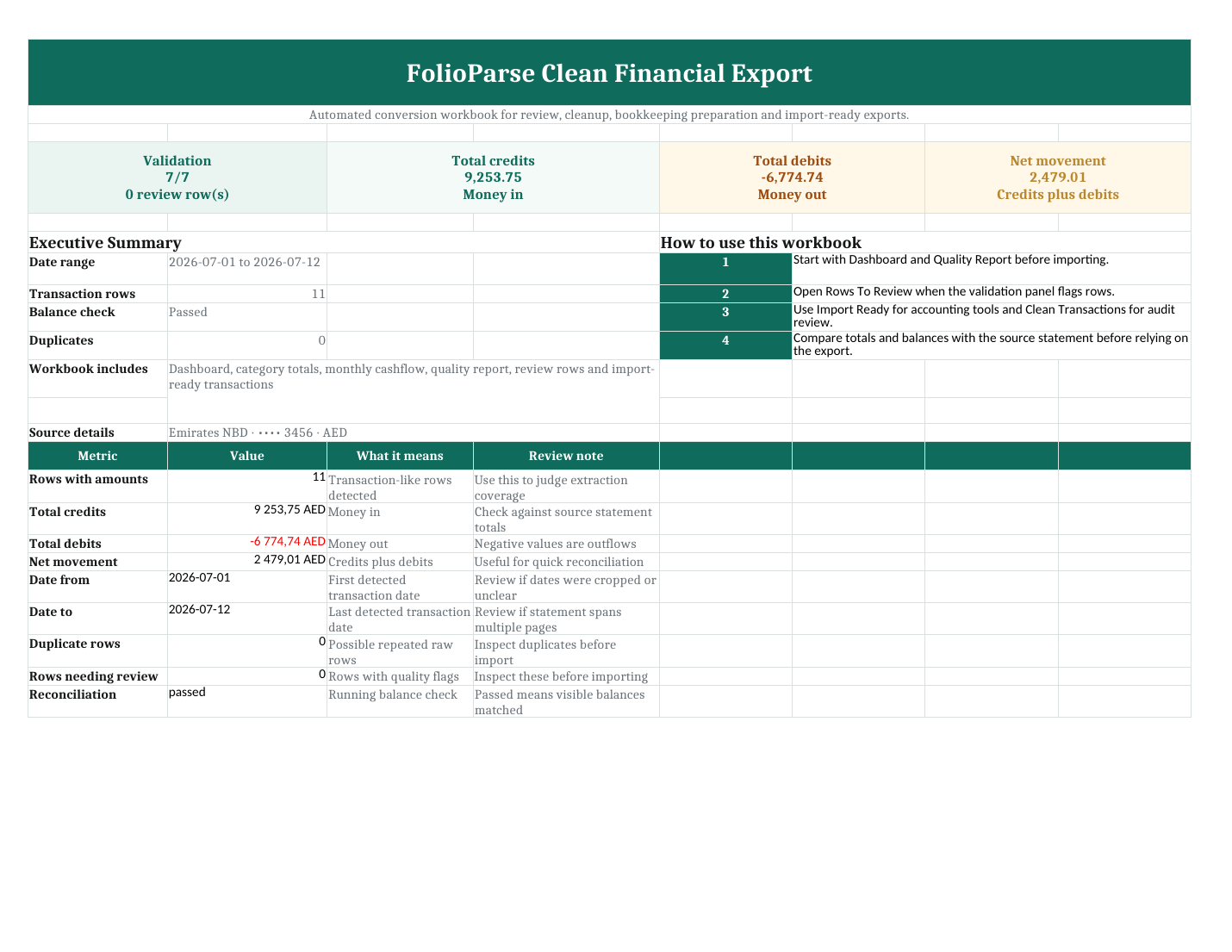
The raw transaction table is only one layer. A practical workbook should also identify rows needing review, summarize totals and preserve a clear route back to the source.
Correct the working copy, never the bank record
If extraction is wrong, edit the spreadsheet or rerun the conversion. Do not alter the original bank statement. Keep the source, converted export and review notes together so another person can reproduce your checks.
FolioParse surfaces warnings and review rows before you download the workbook.
When to reject the conversion
Reject the output when dates cannot be recovered, amounts are attached to the wrong descriptions, most balances are missing, the currency is ambiguous, or reconciliation remains unexplained. A fast conversion is not valuable if the verification cost is higher than manual entry.